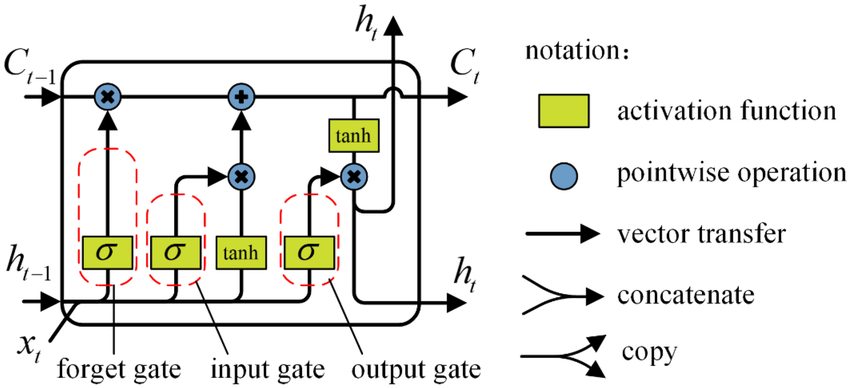
Why gated recurrent networks exist
Standard RNNs lose useful early information as sequences grow and suffer unstable gradients. LSTM and GRU add learned gates so model can preserve or discard state deliberately.
LSTM
LSTM uses input, forget, and output gates plus separate cell state. Extra control can help complex long dependencies, but costs more parameters and slower training.
- Three gates
- Separate cell and hidden state
- Useful for long, context-heavy sequences
GRU
GRU combines memory and hidden state and uses update and reset gates. Simpler structure often trains faster and can match LSTM on smaller or less complex tasks.
- Two gates
- Fewer parameters
- Useful when speed or data is limited
Choose by experiment
Performance gap is often smaller than theory suggests. Train both under same data split, parameter budget, stopping rule, and evaluation metric. Prefer GRU when result is equivalent and operational cost is lower; keep LSTM when measured sequence behavior improves.
- Compare validation variance across seeds
- Measure inference latency and memory
- Inspect long-range failure cases